“I regard consciousness as fundamental. I regard matter as derivative from consciousness. We cannot get behind consciousness. Everything that we talk about, everything that we regard as existing, postulates consciousness.”
~Max Planck, The Observer. January 25, 1931.
They’re wrong.
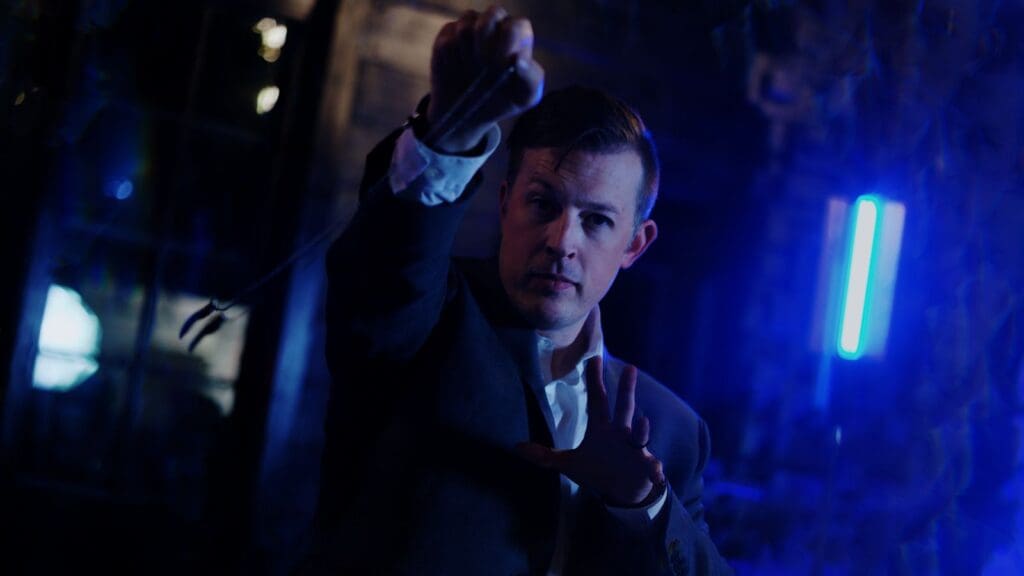
Mentalism is the systematic application of fundamental psychology to create apparently impossible outcomes. It’s the art of leveraging how the human mind actually works to predict behavior, influence decisions, and guide interactions toward predetermined conclusions.
And if that sounds like something that might be useful in business, you’re starting to understand why Fortune 500 companies pay me to teach their teams these principles.
The Fascination: Understanding The Operating System
Here’s what captured my attention at five years old and hasn’t let go since: mentalism reveals the invisible architecture of human decision-making.
Every choice we make, every thought we have, every reaction we display follows predictable patterns. We’re not as random as we think. The human mind operates on principles as reliable as physics. When you understand those principles, you can work with them instead of against them.
This isn’t mysticism. This is applied psychology.
Think about it this way. For thousands of years, humans threw rocks at rabbits. The ancient Greeks contemplated the nature of reality. Newton formalized the laws of cause and effect. Early alchemists explored the properties of metals.
But understanding something only gets you so far.
Everything changed when we started asking: “Now, what can we do with this?”
That question gave us the Applied Physics Laboratory in 1942. Within three years, we unlocked the atom. Regardless of whether you believe that was good or bad for humanity, you cannot deny it gave us unprecedented power to affect the trajectory of all human civilization.
I believe applied psychology holds the same transformative potential.
Psychology tells us how the mind works. What physiological mechanisms are at play. What happens with stimulus and response. What classical conditioning looks like in practice.
Applied psychology asks: “What can we do with this understanding?”
That’s when you unlock the mental atom.
If you understand how and why people think the way they do, you can improve any situation where a human being is involved. And I mean any situation. Anywhere the human mind factors into a dynamic, applying your understanding of psychology leads to greater success.
Why A Business Owner Should Care
Let me give you the direct answer: because this translates into measurable revenue.
When I worked as a graphic designer at a social media agency, they had purchased a database of 39,000 email addresses. Their email marketing efforts had failed repeatedly. The problem wasn’t their service. The problem was their approach.
I applied the same psychological principles I used on stage to rebuild their entire email strategy. We created segmented campaigns. We shifted from polished corporate messaging to conversational, personality-driven content. We offered value before asking for anything.
Within one week of launching the new campaign, the company landed an alcohol distributor with more than 50 labels. The initial contract was worth over $100,000. That doesn’t include the other client work that came through because of the same campaign.
That’s one example. Here are others.
At ROI Trade Shows, I help companies get 2-7 times more qualified leads from their exhibitions by applying the same attention-capture and persuasion principles I developed as a touring mentalist. The United States Postal Service uses these strategies. So does DHL. So do thousands of other companies who recognize that passive approaches lose every time.
When I was the sales trainer at Thrive Agency (the world’s number one digital marketing agency at the time), I helped them completely rearchitect their sales process using these psychological frameworks. I spoke with more than 1,400 business owners across every vertical and business model you can imagine. The patterns became crystal clear.
The companies winning weren’t necessarily the most talented. They weren’t always the most experienced. They were the ones who understood how their prospects actually made decisions and structured their entire sales process around those psychological realities.
I’ve trained the senior leadership teams at BP. I’ve worked with executives at United Airlines. I’ve consulted for State Farm, Discovery Network, and dozens of other organizations you’d recognize immediately.
Why do they hire a mentalist?
Because the same principles that make someone believe I can read their mind on stage make them trust a sales professional in a boardroom. The same frameworks that predict what card someone will choose predict what objections a prospect will raise. The same psychological levers that create wonder in an audience create urgency in a negotiation.
Here’s what most business owners miss: sales is not about convincing. Marketing is not about exposure. Negotiation is not about leverage.
They’re all about understanding the fundamental processes humans use to interact with reality. When you understand that system to its core, you realize it has implications everywhere a human being is involved.
That’s why my work has deep roots in mentalism and eventually grew into sharing the knowledge and skills of communication, influence, and persuasion in sales, marketing, public speaking, trade show strategy, and beyond.
Most companies leave enormous amounts of money on the table because they don’t understand how their prospects think. They pitch features when prospects buy based on emotion. They build rapport when they should be establishing authority. They answer objections when they should be preventing them from forming in the first place.
These aren’t opinions. These are patterns I’ve observed across thousands of interactions in dozens of industries over more than two decades.
The business owner who understands applied psychology doesn’t need to be the loudest voice in the room. They don’t need to have the biggest marketing budget. They don’t need to undercut their competition on price.
They just need to align their approach with how humans actually make decisions.
That’s the competitive advantage mentalism provides.
Why An Audience Member Should Care
Now let’s talk about the experience itself.
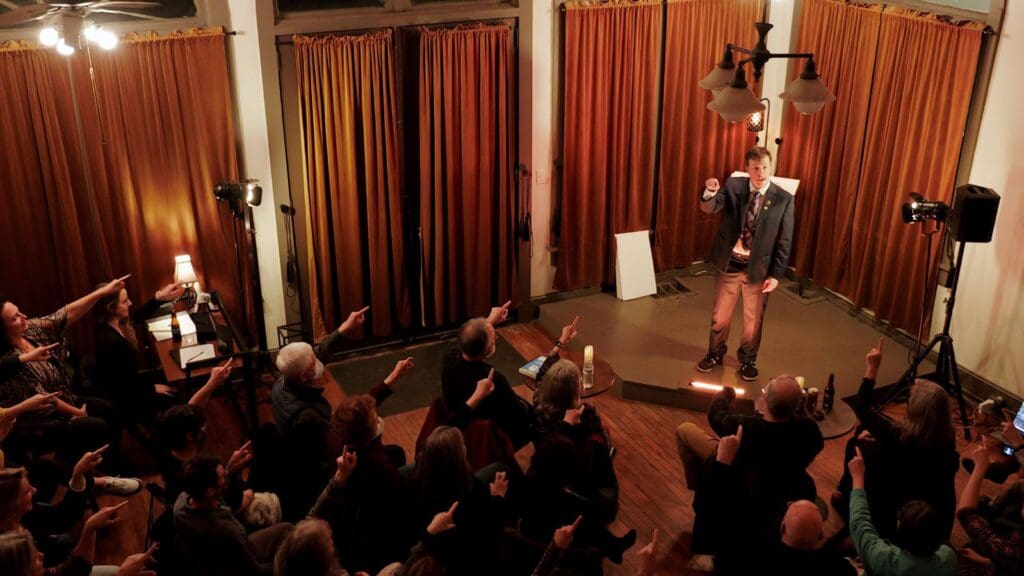
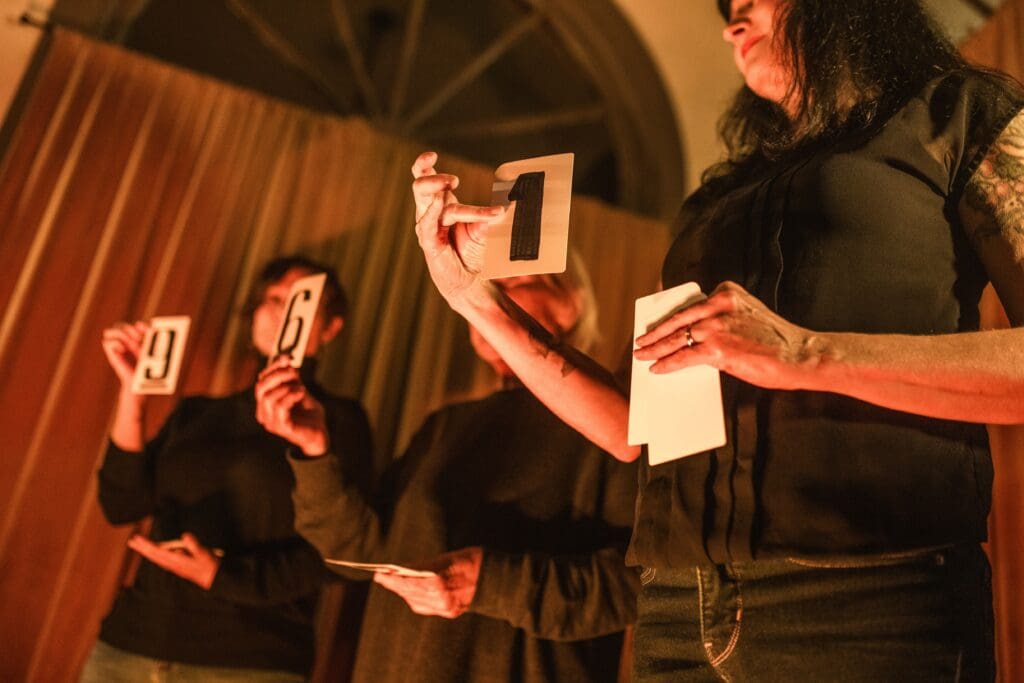
When someone participates in one of my demonstrations, something shifts. I’ve seen it happen thousands of times. The look on their face changes. Their posture changes. Something that seemed impossible just happened, and they were part of it.
That photograph at the top of this page? That’s the moment. That’s what it looks like when someone experiences something that expands their sense of what’s possible.
But here’s what makes this valuable beyond entertainment: it’s collaborative.
I could tell you what I’m thinking. That would be extraordinarily unimpressive. It would only be amazing if I could tell you what you are thinking.
That would be a damn fine trick.
And so it is.
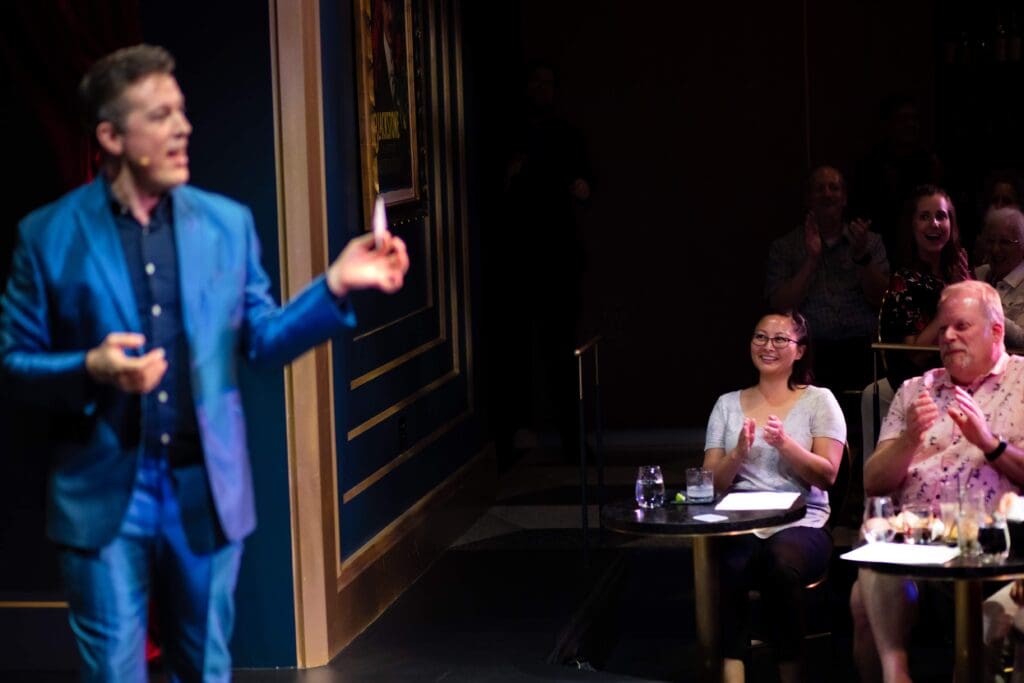
A mentalism show is essentially the performance of uncanny mental powers like reading minds, predicting the future, defying the laws of physics, and leaving an audience questioning the limits of their imaginations. It is completely based on audience interaction and participation.
Without minds to read, there’s not much of a mind reading show.
This means mentalism is much more about collaboration and the wonders of truly being in the moment together than any other type of entertainment.
The number one phobia on earth is public speaking. Yet I regularly bring audience members on stage in front of hundreds of people, and they have the time of their lives. How does that happen?
Applied psychology.
I’m combining fundamental principles of motivation with communication skills, persuasion frameworks, and trust-building techniques. I’m creating an environment where people feel safe enough to be vulnerable, excited enough to take risks, and supported enough to succeed.
My mission as an entertainer is to help my audiences be the stars of the show. I am a facilitator who knows how to make people feel like a million bucks and have fun on stage in front of their friends.
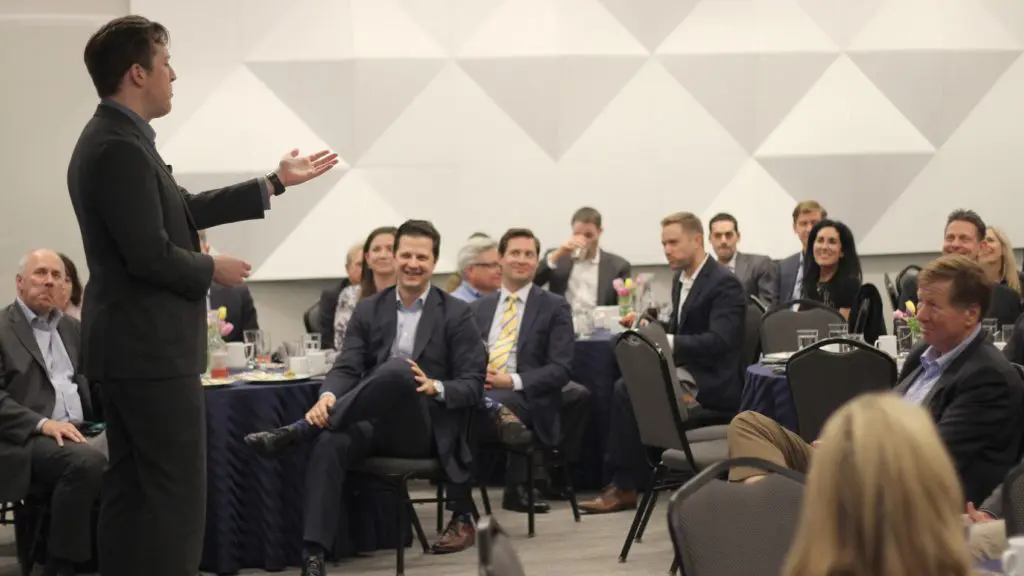
Every presentation is different because every audience is different. The demonstration that works with engineers at a technical conference won’t land the same way with sales teams at a corporate retreat. The approach that succeeds with C-suite executives requires different calibration than what works at a company holiday party.
That adaptability comes from understanding the underlying psychology. When you know how people think, you can meet them where they are instead of forcing them to meet you where you are.
The result? Audience members walk away having experienced something genuinely memorable. Not because I did something to them, but because we created something together.
They remember the brand if it’s a corporate event. They remember the message if it’s tied to a marketing campaign. They remember the feeling long after they forget the specific tricks.
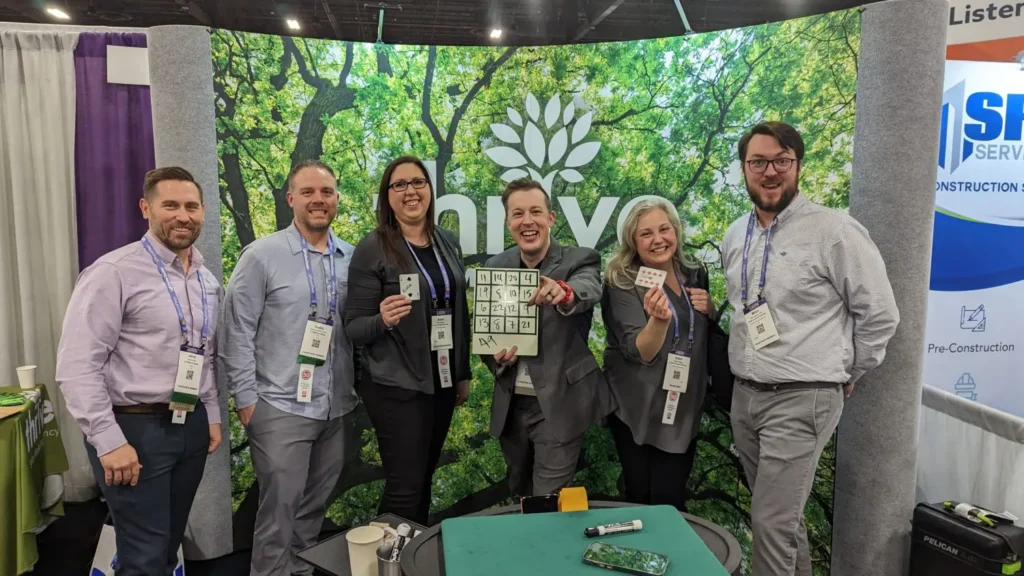
That’s the power of experiential marketing. That’s why companies bring me to trade shows where attendees are staring at their phones, shields up, actively avoiding sales conversations. Within minutes, I have crowds of 15-20 people gathered, engaged, and hearing marketing messages woven seamlessly into an entertaining experience.
Those attendees don’t feel sold to. They feel like they participated in something special. And when they remember back to the fun they had, they can’t help but remember the brand too.
The Unique Positioning
Here’s what makes my approach different from every other business consultant, sales trainer, or marketing expert you might work with:
I’ve done more than 15,000 live performances.
That’s not a typo. In my first job out of college, I worked at a magic shop in Universal Studios Orlando. In under three years, I performed live demonstrations more than 15,000 times while selling over $1 million in product. We became the number one third-party vendor in the entire park.
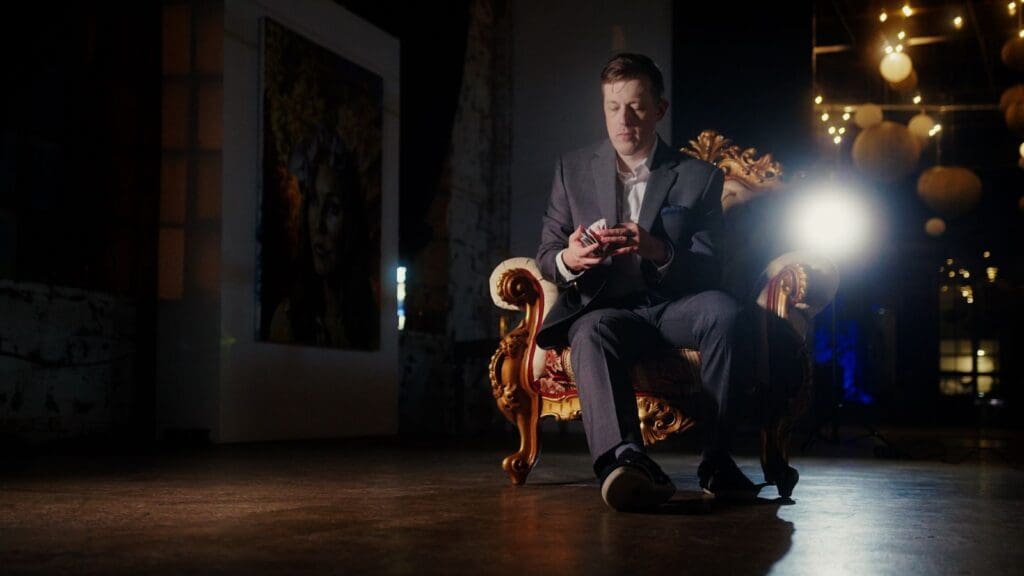
After that, I was the tour manager for Brian Brushwood, writing and ideating his show “Scam School” which garnered him more than one million subscribers. Then I went out on my own as a full-time touring mentalist, traveling the world using applied psychology, showmanship, and moxie to make people think I could read minds, predict the future, and demonstrate other apparently psychic abilities.
Then I realized something critical: the psychological principles that made the show work on stage helped me be a successful business owner off stage. My insights could help businesses at large.
That’s when I transitioned into business consulting.
Most consultants have theories. I have data from thousands of real-world interactions where I had seconds to capture attention, minutes to build trust, and one shot to create a memorable experience that led to a desired outcome.
Most sales trainers teach scripts. I teach the underlying psychology that makes any script work.
Most marketing experts focus on platforms and tactics. I focus on the fundamental human behaviors that make any platform or tactic effective.
I’m not asking you to trust my credentials or my case studies or my client list, though all of those exist. I’m asking you to recognize that someone who has successfully read minds for a living might have insights into how minds actually work that could benefit your business.
At 13 years old, I got paid $200 to entertain families at a company picnic. I’ve been supremely unemployable since then. Everything I’ve built has come from understanding how to capture attention, build trust, deliver value, and create outcomes that seem impossible until they happen.
Now I own a fractional CMO business. I run a trade show marketing firm. I consult with creators and entrepreneurs. I’ve written several books about the power of applied psychology, all available on Amazon.
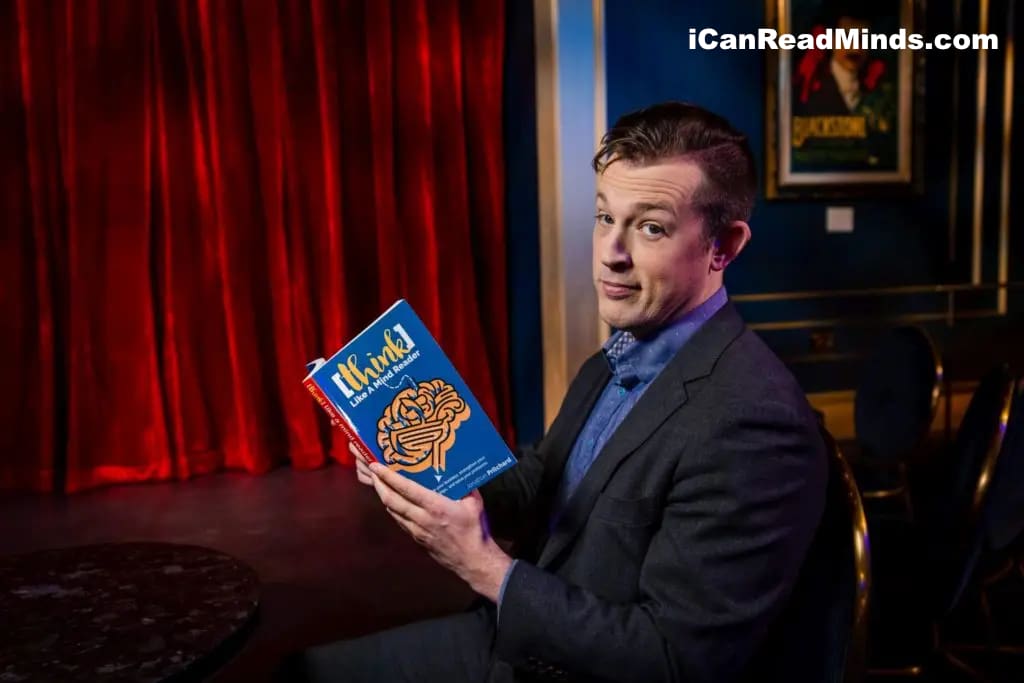
“Think Like A Mind Reader” answers the 20 most common questions I got from audience members after my mentalist shows, ranging from how I got started to how to stay motivated to how to be more persuasive.
“How To Remember Anything” introduces readers to mnemonic techniques.
“Sell Like A Mind Reader: The Discovery Call” is the first in a series dedicated to sharing my psychology-powered sales process that I taught at Thrive Agency.
“Trade Show Lead Machine” explains my approach to planning trade shows and how an in-booth presenter (my term for an infotainer like me who combines performing skills to gather an audience with marketing skills to craft compelling messages) can transform results.
I’ve also built a 7,000-subscriber YouTube channel focused on personal productivity, taught seminars at Berea College where I earned my Bachelor of Fine Arts, and worked with James Randi for 13 years helping handle applications for his million-dollar paranormal challenge and organizing his annual science conference.
The through-line in all of this work is simple: understanding how the mind works gives you an unfair advantage in any situation involving human beings.
That advantage compounds over time. The sales professional who understands psychology closes more deals. The marketer who understands psychology creates more compelling campaigns. The leader who understands psychology builds more effective teams. The entrepreneur who understands psychology builds more sustainable businesses.
This isn’t magic. This is mentalism. This is applied psychology. This is the systematic application of fundamental principles to create apparently impossible outcomes.
And it works.
If you’re a business owner looking to increase revenue, close more deals, generate better leads, or build more effective systems, you need someone who understands not just what to do, but why it works.
If you’re planning an event and want an experience your audience will actually remember instead of another forgettable keynote or comedy act, you need someone who can create genuine moments of wonder while delivering your marketing message.
If you’re serious about competitive advantage in a marketplace where everyone has access to the same tools and tactics, you need someone who understands the underlying psychology that makes any tool or tactic effective.
That’s what mentalism offers. That’s what I bring to the table. That’s why companies trust me with their most important sales conversations, their highest-stakes presentations, and their biggest marketing investments.